SOUTHERNBREEZE
GOLF
TOURS
'Catch
a SouthernBreeze!'
 ©
1999 - 2013
©
1999 - 2013
is
a division of
Gardner
Travel Service, Inc.

|
|
A SouthernBreeze
Golf
Click
on any of the links above to review the courses, accommodations and to
request rates and availability
INNISBROOK GOLF
RESORT
72
Holes of Award Winning Championship
Golf
The
Courses
In
golf, it's not whether you win or lose, it's where you play the game.
And
at Innisbrook, you'll play 72 holes of the country's very best.
|
Copperhead
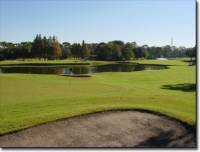 The
Copperhead undoubtedly is The golf course that
most
lovers of golf are familiar with. After all, they've seen America's
greatest
golf stars taking on its pine tree-lined fairways and rolling terrain
during
the Chrysler Championship each fall. So you, like many other visitors
to
Innisbrook, will want to make the Copperhead one of your must-places to
play. The
Copperhead undoubtedly is The golf course that
most
lovers of golf are familiar with. After all, they've seen America's
greatest
golf stars taking on its pine tree-lined fairways and rolling terrain
during
the Chrysler Championship each fall. So you, like many other visitors
to
Innisbrook, will want to make the Copperhead one of your must-places to
play.
With
its unusual elevation
changes, the natural setting of the Copperhead course will probably
remind
you of a Carolina layout rather than Florida's West Coast. The
Copperhead,
of course, is ranked in "America's Top Resort Courses" by Golf Digest
and
No. 4 in the state by Travel & Leisure Golf's Florida's 50 Finest.
From
the tournament tees
Copperhead presents a stern test of golf. At 7,300+ yards, this
par-71
layout is designed to challenge the players of all ability levels. The
Copperhead Practice Facility is located adjacent to the first hole and
is complimentary to those with a tee time on the course.
"The
course is a daunting
layout," says Chris Card, Director of Golf. "Larry Packard put
together
a stunning design...he combines narrow, tree-lined fairways with
elevation change and very firm, fast greens. It's absolutely
breath-taking
from tee to green."
The
course opens with a par-5
(560 yards from the back tees and 450 from the forward) that is a
sweeping
dogleg right with a tee box perched some 50 feet above the fairway. The
placement of the second shot must be accurate to set up a birdie chance
here.
One
of the favorite holes
here is the par-5 No. 5 (605 yards from the back tees and 465 from the
forward). This is a hole that's challenging from tee to green. You'll
be
happy to walk away with a par on this hole. "It has a huge uphill
elevation
change from the tee to the landing area," says Tony Arielly, our
director
of group sales. "Then about 200 yards out from the green, it starts to
drop dramatically back down. You have a blind shot for your second shot
going over the hill. Then the green slopes away from you as you make
your
approach shot." Despite the difficulties, this is one of our
most-photographed
holes.
No.
14, a par-5 that measures
570 yards from the back tees and 510 from the forward, is another of
Lawrence
Packard's famous double doglegs - one that goes right, left and then
right
to the green. It's definitely a risk-reward par-5. "If you can carry
water
on the right and avoid a massive bunker on the left, you may get a
birdie,"
says Arielly. "You don't want to make a mistake on your second shot.
There's
a two-tiered green so if you're short, your ball could roll back down
off
the green. If you're long, it could roll the other way."
|
|
Island
 Ample
water, tight fairways, intimidating hazards, and abundant bunkers --
all
designed to test the skills of the most accomplished golfer have won
much
acclaim for the Island Course at Westin Innisbrook.
The Island, often considered to be just as
challenging
as the Copperhead, is ranked among the country's top 50 resort courses
by Golf Digest and No. 14 in Travel & Leisure Golf's "Fifty Finest
in Florida." Ample
water, tight fairways, intimidating hazards, and abundant bunkers --
all
designed to test the skills of the most accomplished golfer have won
much
acclaim for the Island Course at Westin Innisbrook.
The Island, often considered to be just as
challenging
as the Copperhead, is ranked among the country's top 50 resort courses
by Golf Digest and No. 14 in Travel & Leisure Golf's "Fifty Finest
in Florida."
The
varying terrain, coupled
with a variety of tee placements, can challenge both the professional
player
as well as the weekend golfer. The course has been a regional qualifier
for the U.S. Open and is remembered as well for the NCAA championship
that
Phil Mickelson won here in 1990.
One
of Innisbrook's four
championship courses, the Island Course, was the first to open for play
in December of 1970. There are 18 truly unique holes here. "This is a
long
par-72 course with water in play on at least half the holes," says
Brock
Nicholas.
The
Island offers enchanting,
picture-postcard scenery. "You'll find tall pines draped with Spanish
moss,"
Nicholas says, "and lots of serene views. I love the Island Course.
It's
tighter off the tees and just as tough as the Copperhead. You need to
be
straight here."
The
Island's first six holes
are dominated by lateral water hazards and fairly level terrain which
require
pinpoint accuracy on both tee shots and approaches. The middle six
holes
feature rolling hills dominated by cypress and pine trees. The final
third
of this course boasts a mixture of holes designed to reward the bold
yet
penalize the errant golf shot. The golf course winds down to a
finishing
hole that will test the nerves of even the most steady player.
Your
first hole is a par-4
(372 yards from the back tees and 322 from the forward). It's dogleg
right
with a well-protected green. Water runs along the right side of the
hole
and there are bunkers on both sides of the green. But this opening hole
is a birdie opportunity.
The
signature hole on this
course is No. 7, a par-5 dogleg-left that plays at 565 yards from the
back
tees and 467 from the forward. This could be the most treacherous test
you'll face on the Island. "This is a very tight driving hole," says
Nicholas,
"with water and trees on the right. The second shot is tight as well
with
a lake on the right."
Keep
in mind on No. 7 that
from the fairway to the green, the ground rises uphill about 60 feet.
There's
a green here that's well-protected with multiple-lobed bunkers.
The
No. 9 hole on the Island
Course is another toughie. "It's a par-4 that plays 415 yards from the
back tees (329 yards from the forward). It's a dogleg left, but it's
easy
here to run through the fairway and into the woods if you're too daring
off the tee," says Tony Arielly.
Your
approach shot on No.
9 requires a shot over water to a green that's surrounded by bunkers.
The
finishing hole on this
course is very similar to No. 9 in its layout. It's also one of the
most
photographed holes in the state of Florida if not in the nation. "It's
a narrow dogleg-left par-4 (370 yards from the back and 290 from the
forward
tees) with trees on the right side and lots of water on the left," says
Arielly. "There's also water in front of the green. You need to use a
fairway
wood or a long iron off the tee to try to hit around the corner. It's a
make-or-break hole." On this hole the green also slopes toward the
water.
|
|
|
Highlands
South
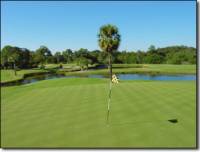 The
Highlands South Course stretches almost 6,800
from
the back tees, this course features the longest Par 5 in the state.
Highlands
South promises undulating terrain and elevation that brings the wind
into
factor when making club selection. Ample waste bunkers and 10 water
hazards
offer a great challenge. The
Highlands South Course stretches almost 6,800
from
the back tees, this course features the longest Par 5 in the state.
Highlands
South promises undulating terrain and elevation that brings the wind
into
factor when making club selection. Ample waste bunkers and 10 water
hazards
offer a great challenge.
This
course is almost a links
style, says Tony Arielly, both in its set-up and the way it plays with
its fairway bunkers and rolling terrain.
You'll
get off to a moderately
easy start with a straightaway par-4 that plays at 335 yards from the
back
tees and 250 from the forward. You do have to avoid a large bunker on
the
left and trees on the right.
There's
a great par-3 on
the third hole that measures 180 yards from the back tees and 100 from
the front. This hole has a very narrow green that measures about 40
feet
at its deepest point. There's plenty of water in front of the green.
Accuracy
and distance control is very important here. "If you're short, you'll
end
up in the water. If you're long, you'll be in the back bunker," says
Arielly.
The
No. 9 hole on this course
is also a challenging par-3 that plays at 210 yards from the back tees
and 160 yards from the forward. It's not a true island green, but it's
surrounded on three sides by water on the sides and in the back. It's a
peninsula surrounded by bulkheads. You have to hit a very straight shot
to this large, two-tiered green that slopes back to front.
This
hole is definitely affected
by the wind in front of you or behind you. It's all carry here,
although
short of the green is a lay-up area.
Our
No. 13 hole on the Highlands
South is the longest par-5 in the state of Florida. The back tees are
placed
at 630 yards; the forward at 450. The back tees are only for the
strong-willed
player on this double dogleg. The difficulty here is mostly in the
length
and in the moguls that will bump your ball up and down the fairway. A
nest
of fairway bunkers guard the approach area on your second shot. There's
not a flat lie anywhere. "It's a long shot into the green on your third
shot," says Arielly.
No.
18 is a picturesque par-3
finishing hole (185 yards from the back tees and 150 from the forward)
that requires a medium to long iron shot over water to a deep green.
|
|
Highlands
North
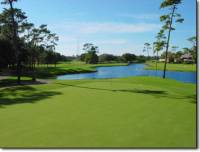 This
beautiful 18-hole layout features tight fairways and well-bunkered
greens,
placing a costly premium on accuracy from tee to green. Recent course
improvements
include longer, more challenging par-4s and -5s with added bunkers and
waste areas to create greater penalties throughout for those errant
approach
shots. This course is known for its daunting par-3s. "This is known as
a shotmaker's course," says Tony Arielly. "There's definitely a premium
on accuracy and not so much on distance." This
beautiful 18-hole layout features tight fairways and well-bunkered
greens,
placing a costly premium on accuracy from tee to green. Recent course
improvements
include longer, more challenging par-4s and -5s with added bunkers and
waste areas to create greater penalties throughout for those errant
approach
shots. This course is known for its daunting par-3s. "This is known as
a shotmaker's course," says Tony Arielly. "There's definitely a premium
on accuracy and not so much on distance."
Also
designed by Lawrence
Packard, the Highlands North at
Westin Innisbrook is similar in terrain to the Copperhead Course, but
not
in length. Rolling fairways and water throughout make club selection
your
most important strategy on this course. About 6,600 yards from the back
tees, this course is known for its long par-3s and small greens. Ball
placement
becomes critical.
Although
it's our shortest
course, it's one of our most challenging. In fact, 11 of the 18 holes
here
have water on them. The other seven have narrow fairways with lots of
trees
and bunkers.
The
signature hole here,
says Brock Nicholas, is No. 3, a 470-yard par-4 that is a tight driving
hole (345 yards from the front). "It's straightaway, but there's water
on the right and left and rough farther down on the right. Then you
have
a long carry to a partial island green." You will need a long and
accurate
drive to get started on this hole.
One
of the most scenic holes
here is No. 5, a dogleg-right par-4 (410 yards from the back tees and
300
from the forward) that curves around the water. Your second shot has to
take you onto an island green. "Whenever you say the words 'island
green,'
it puts fear into the heart of golfers," says Arielly. "On top of it
all,
you can't see the island green from the tee because this is a pretty
sharp
dogleg. You have to hit down a chute of trees off the tee. If you go
too
far right, you're in the water."
No. 8
is an excellent par-5
(510 yards from the back tees and 425 from the forward). It's a
90-degree
dogleg right uphill with a river running across the fairway. Golfers
who
like to gamble will love this hole, especially if they can hit the ball
well. "The brave will use their driver off the tee to try to go over
the
river," says Arielly. "But most golfers will lay up in front of the
water
and then go uphill. On the second shot, you start all over again by
trying
to hit a cut shot over 50-foot trees."
No.
14 is one of Arielly's
favorites. It's a par-4 dogleg left that measures 400 yards from the
back
tees and 320 from the forward. You hit off the tee to the landing area
through a tunnel of trees. Your approach shot requires hitting over a
river
and lake combination that goes all the way across the fairway. "If you
hit a bad drive, you may have to lay up short of the water and take a
third
shot over the water," he says.
|
|
A
Southern
Breeze Golf
ORDER
YOUR INNISBROOK
RESORT GOLF PACKAGE TODAY AND SAVE!

Click on any
of the links
below to review the courses, accommodations and to request rates and
availability
  

golf@gardnertravel.com

  
We can also package and
assist in
the following golf-themed outings:
CORPORATE
EVENTS CHURCH
GROUPS CHURCH
GROUPS
FRATERNITY/SORORITY/ALUMNI
GETAWAYSREUNIONSRETREATS
BACHELOR
PARTY GOLF OUTINGSGIFT
CERTIFICATES
TOURNAMENT
PRIZES
OUR
HOURS
ARE
Monday -
Friday from
8:30am to 5:30pm
Proudly
associated with

Authorized
Representative

Central
Standard Time
TOLL
FREE
877-510-4653
or
1-817-788-5210
for some parts of Canada
|